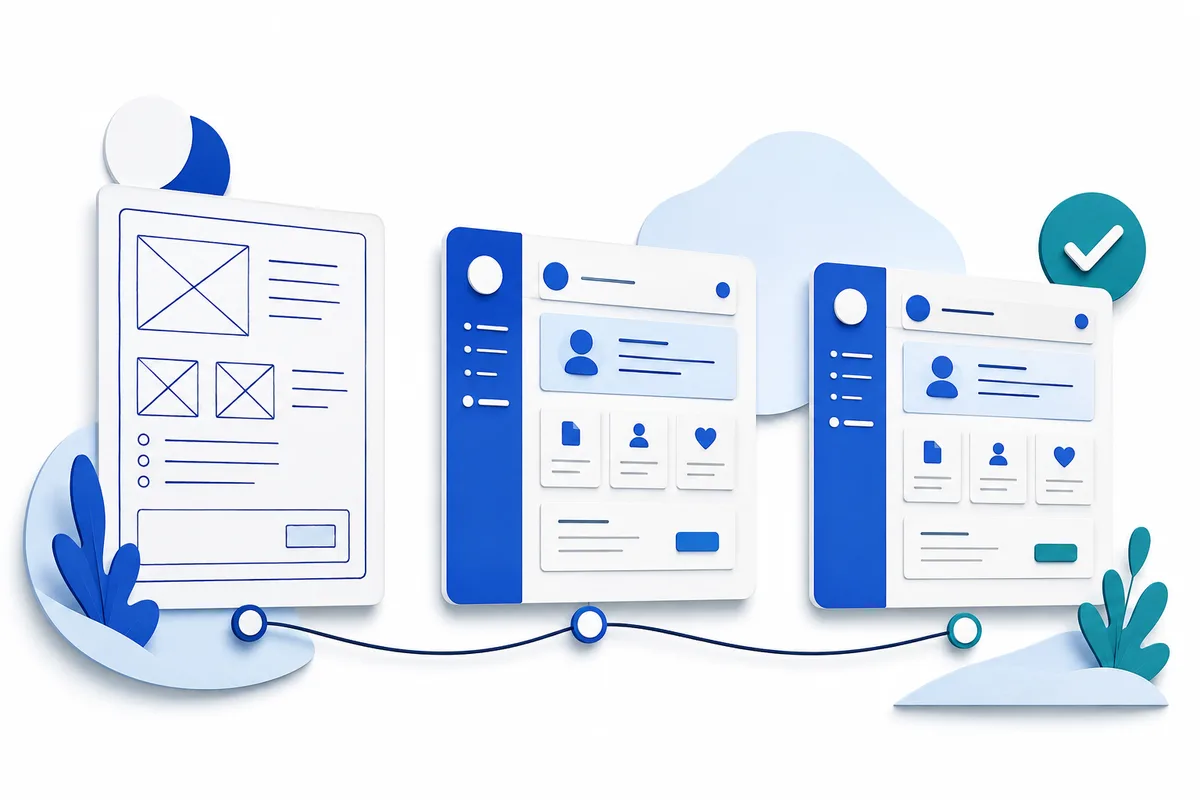
A prototype answers a question
Select a step to see the explanation.
Define an uncertainty you can test. A long feature list is not a test objective.
A prototype is useful when it reduces an important uncertainty. It can show whether people understand a workflow, whether data fits together or whether a technical connection is feasible. A clear question makes it easier to build the right prototype.
A question instead of a feature list
“We need a customer portal” describes an idea. “Can customers find their request status without contacting us?” describes a question you can test. A few screens with example data may be enough to investigate it.
Write down the decision you want to make afterwards. If no possible result would change that decision, you may not need a prototype for this particular question.
Choose the smallest complete journey
A small scope should still show a connected path: an entry point, an input, a result and an important exception. A collection of attractive but disconnected screens tells you little about whether the overall workflow makes sense.
Make example data recognisable. Document simulated connections. A prototype does not prove that an integration is already available.
Gather feedback through a task
Ask people from the intended audience to complete a specific task. Observe where they hesitate, go back or need help. Asking whether they like the design gives different information from watching them use it.
Separate observations from interpretations. “The person did not find the status” is an observation. “We need a larger button” is already a proposed solution that still needs checking.
Recheck before production use
A successful test leaves other questions open: real permissions, personal data handling, errors, operation, recovery and message delivery. Which questions matter depends on the product.
Plan this transition explicitly. A prototype may deliberately simplify parts of a system. A production solution needs the agreed functionality and evidence that it operates under the intended conditions.
Finish with a clear decision
Record the answer, the main observations and the next step. That might be implementation, one more focused test or a decision not to pursue the idea.
Planning an application? Our software development starts with your task. Tell us about it.