
Our AI Platform connects customer enquiries with company knowledge and a controllable handover to people. Here we explain which parts of this workflow we have actually developed, where the limits lie and how a company can calculate potential time savings.
This is a technical account of our own product, not a success story about an anonymous client. The described functionality was checked against the project's development state on 10 September 2026. The hours below are explicitly a model calculation: this article is not based on measured before-and-after processing times from a customer.
The task: finding the same information again and again
A service business receives similar questions through different channels: Which documents do you need? How does working with you work? Which service fits my request? A person reads the message, looks up information, writes a response and asks colleagues about exceptions.
This is a typical starting workflow that we consider for this article. It is not a retrospectively reconstructed observation from a particular client's business. The difficulty is handling routine enquiries without automatically making individual commitments, disclosing confidential information or mishandling complaints.
An assistant should primarily reduce searching and drafting work here. It should neither turn a general price list into a binding quote nor dispose of a difficult complaint with a plausible-sounding standard answer.
What we built into the platform
The LindenTech AI Platform takes messages from connected channels through a shared processing workflow. This includes the following components, which can be traced in the source code:
| Component | Its job | Important limit |
|---|---|---|
| Conversation and message history | A new message is processed in the context of its conversation. | History does not replace current business data. |
| Document knowledge search | Relevant passages from the agent's knowledge base are retrieved for a question. | Text similarity is not proof that an answer is correct. |
| Answer generation | The model writes an answer using the supplied context. | Approvals and responsibilities must fit the use case. |
| AI reply controls | Disabled, paused or archived conversations are taken into account. | A human contact point must actually be staffed. |
| Separate processing steps | Context retrieval, answer generation and delivery are separate steps. | A generated answer is not yet a successfully delivered message. |
The search can be restricted using, for example, the number of results and a similarity threshold. That threshold assesses document retrieval. It is not a percentage measure of an answer's truth.
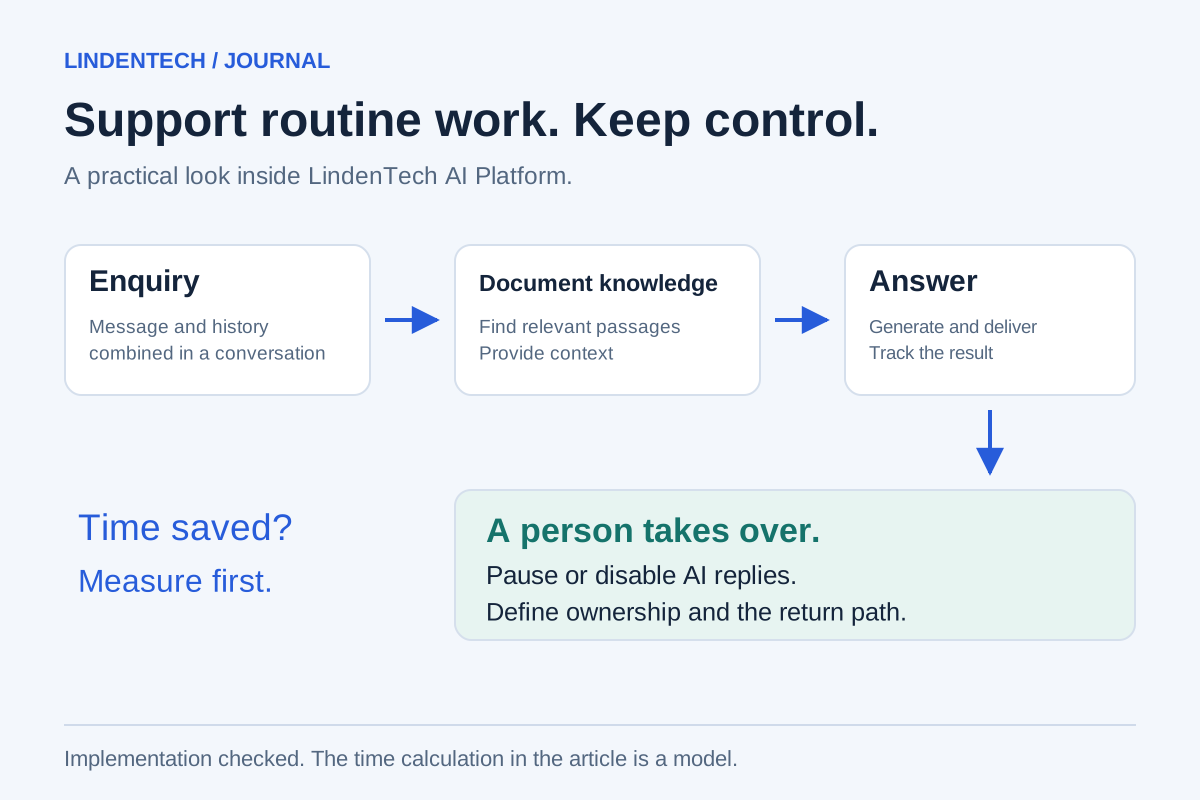
The workflow before and with assistance
| Work step | Fully manual | With an appropriately configured assistant |
|---|---|---|
| Check the incoming request | Every message is read individually. | An incoming message starts the processing workflow. |
| Find information | A person searches documents or asks a colleague. | Knowledge retrieval supplies relevant passages. |
| Write the answer | The answer is written manually. | The model writes within the agreed scope of work. |
| Resolve an exception | A person decides and replies. | A person takes over; AI replies are paused or disabled. |
| Improve quality | Individual errors are corrected. | Recurring problems inform document maintenance and test cases. |
The right-hand column describes the intended workflow using these components. In particular, deciding which enquiries may be answered automatically and organising handover are part of configuration. A technical switch alone does not organise customer service.
Why handover is more than a contact link
The message process checks whether automatic replies are enabled for the conversation and whether a pause applies. Processing can therefore stop before another AI answer is generated. The platform also has a check before delivery that takes account of a pause introduced in the meantime.
For WhatsApp and Instagram, the platform also describes handover through detected replies from the business. Which option is available depends on the connected channel and its configuration. This is not a blanket promise that every messaging app supports the same handover feature.
Three practical questions remain for operation: Who takes over? Where does the task appear? When may automatic replies resume? A team needs concrete answers. A notification without an owner leaves a customer waiting just as an unattended inbox does.
An honest hours calculation: an example with 500 enquiries
For initial planning, we use the following chosen assumptions, not project results:
- 500 enquiries per month, previously requiring 6 minutes of work each.
- After configuration and assessment, 60 percent are suitable for automatic handling.
- For these 300 cases, we allow an additional average of 0.5 minutes of human checking per case.
- The remaining 200 cases still require 6 minutes each.
- Document maintenance, error review and operation require another 3 hours per month.
| Calculation | Time in this example |
|---|---|
| Before: 500 × 6 minutes | 50 hours |
| Checking automatically handled cases: 300 × 0.5 minutes | 2.5 hours |
| Cases still handled manually: 200 × 6 minutes | 20 hours |
| Additional maintenance and quality assurance | 3 hours |
| New total workload | 25.5 hours |
| Calculated difference | 24.5 hours per month |
Setup and training are not included in this monthly calculation. Nor does an hour freed up automatically equal an hour of payroll savings. The team could use the time for more demanding advice, for example. If fewer cases are automated or more follow-up questions arise, the reduction will be smaller.
The general calculation is: previous workload minus remaining manual work minus checking minus ongoing maintenance. For a business decision, put the assistant's running costs alongside it.
What we would measure before making a reliable success claim
Before the pilot, select representative enquiries, including incomplete questions and complaints. Record active handling time and waiting time separately. A customer might receive a first answer sooner while staff workload stays unchanged.
Then compare similar cases over a sufficiently long period. Alongside time, record factual errors, repeated follow-ups, handovers and enquiries actually resolved. Document the sample size and whether enquiry volume changed.
Only these data justify a statement such as “We save 24 hours a month.” A demo and an existing process in source code do not. Anyone planning a pilot can use the table above as a measurement template and replace each assumption with an observation.
The key limit: missing knowledge remains missing knowledge
In the retrieval component we examined, a technical error results in empty context with an error indicator. That is technical error handling, but it does not by itself decide whether the assistant should remain silent or escalate. This behaviour must be defined and tested across the entire workflow.
That is exactly why every acceptance test should include questions with no matching documents. Our RAG guide explains how knowledge retrieval works. Additional safeguards are covered in the article on customer service hallucinations.
A practical starting point for your own pilot is a manageable set of cleaned-up example enquiries, the corresponding approved information and a person who can judge correct answers. Describe your workflow: first we can assess which work is suitable for automation and which should deliberately remain with the team.
Basis of this practical account
The primary basis is our own implementation of message processing, document retrieval and conversation controls in AI Platform, checked on 10 September 2026. The public product page explains its scope. This account does not use private customer conversations, customer names or unsupported success metrics.