
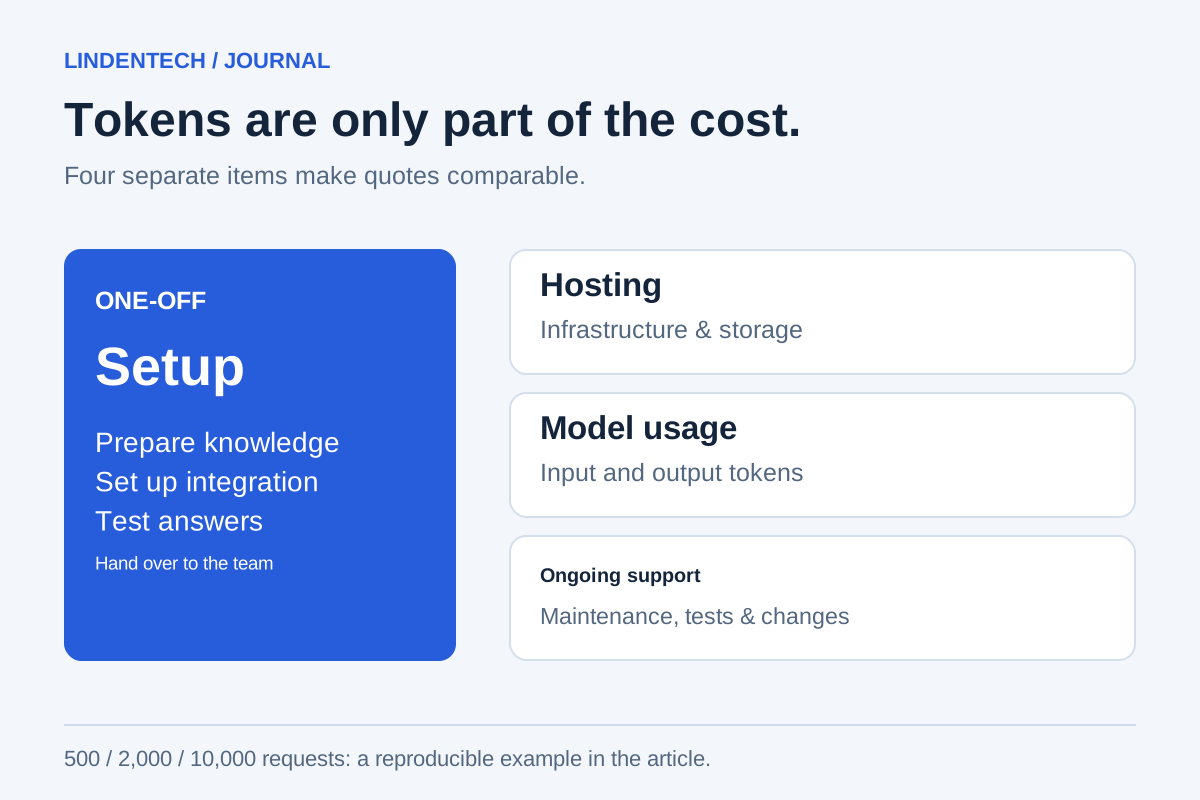
A small AI assistant may generate only a few dollars a month in model charges. A reliably maintained business service costs more: someone must prepare the content, secure access, check answers and manage changes. Comparing only token prices is like comparing a machine's electricity consumption with the cost of running the entire workshop.
For a modest website assistant, an illustrative setup budget of €1,500 to €5,000, plus hosting, model usage and ongoing maintenance, can be a useful starting point. This is an editorial estimate for the scope described below, not a market statistic or a LindenTech quotation. Existing standard products may cost less; custom integrations may cost considerably more.
Three cost categories every quotation should show
| Cost category | What it pays for | Possible billing method |
|---|---|---|
| Setup | Goals, knowledge preparation, configuration, integration, testing and handover | One-off or by project phase |
| Technical operation | Application, database, search, backups and monitoring | Monthly base charges plus usage |
| Usage and maintenance | Model calls, messaging channels, quality checks and changes | By usage, hours or an agreed package |
A low monthly fee means little if document updates always cost extra or every handover to a person incurs another charge. Equally, a more expensive package is not necessarily poor value if it genuinely replaces ongoing work. What matters is the complete scope of the service.
Which setup range fits which project?
The following amounts are deliberately labelled as planning assumptions in euros, excluding VAT. They correspond to an assumed 15–50, 50–150 and 150–400 hours at a purely illustrative rate of €100 an hour. This rate is not a published LindenTech price list.
| Example scope | One-off planning budget | Assumptions used here |
|---|---|---|
| Website information assistant | €1,500–€5,000 | One language, existing verified content, no customer-data lookup, simple contact handover |
| Assistant with one integration | €5,000–€15,000 | Adds one documented interface, defined access rights and business acceptance tests |
| Custom process assistant | €15,000–€40,000 or more | Several systems, roles, approvals, error handling and more extensive operational requirements |
These figures exclude, for example, cleaning up legacy customer data, comprehensive legal advice, developing new third-party interfaces or providing a continuously staffed human support desk. These items particularly need clarification before agreeing a fixed price. PDF count alone is not a useful measure of effort: ten conflicting price lists can require more work than a hundred well-organised help pages.
Token costs: a calculation you can reproduce
We use GPT-5 mini for this example without recommending it for every task. The standard price checked on 10 September 2026 is $0.25 per million input tokens and $2.00 per million output tokens. A lower rate exists for reused inputs, but we do not apply it here. Source: official model and pricing documentation.
In this calculation, a “request” means exactly one model call, not an entire conversation. We assume an average of 3,000 input tokens covering instructions, the question, history and retrieved passages, plus 600 billable output tokens. Those output tokens must include internal reasoning tokens where applicable; 600 visible answer tokens would not provide a reliable upper limit.
Cost per request = (3,000 × 0.25 + 600 × 2.00) / 1,000,000 = 0.00195 USD.
Know your own volume? Use the calculator at the end of this article to change the number of calls and tokens directly.
| Model calls per month | Input tokens | Output tokens | Model charges only, per month |
|---|---|---|---|
| 500 | 1.5 million | 0.3 million | 0.975 USD, rounded to 0.98 USD |
| 2,000 | 6 million | 1.2 million | 3.90 USD |
| 10,000 | 30 million | 6 million | 19.50 USD |
These are calculations under fixed assumptions, not measured customer data. A conversation with five such calls costs five times as much. Search tools, embeddings, file storage, voice, images, additional model calls, retries and channel fees are excluded. Taxes, currency conversion and payment charges are also excluded. We therefore avoid converting dollar amounts into euros with misleading precision.
Hosting and maintenance need separate budget lines
The next table is an additional editorial budget illustration, not a calculation derived from provider prices. It assumes a small managed application with limited data, backups and basic monitoring, without a guaranteed round-the-clock response time. Maintenance assumptions represent one to three, two to six and four to twelve hours a month at the illustrative hourly rate above.
| Model calls per month | Hosting, database and search | Maintenance and content review | Model charges from the example |
|---|---|---|---|
| 500 | €20–€80 / month | €100–€300 / month | 0.98 USD / month |
| 2,000 | €40–€150 / month | €200–€600 / month | 3.90 USD / month |
| 10,000 | €100–€400 / month | €400–€1,200 / month | 19.50 USD / month |
The rows describe three planning scenarios, not technically necessary consumption tiers. A well-configured application may handle 10,000 calls on a smaller hosting package. Conversely, high concurrency, large search indexes or strict availability requirements may increase costs even with little traffic. Maintaining the service internally does not eliminate the work; it transfers it to your team.
When does the investment make economic sense?
Count demonstrably saved minutes, not the number of answers generated. For example, if 300 tasks each month genuinely take four minutes less, that frees 20 hours. At assumed fully loaded internal costs of €40 an hour, this represents €800 of theoretical capacity. Deduct review, rework and operating effort. Spare capacity is not automatically an equivalent cash saving.
During a pilot, compare similar tasks before and after implementation. Record incorrect answers, abandoned chats and necessary follow-up questions too. A bot that appears to “resolve” enquiries but causes extra phone calls afterwards does not improve the result.
Five questions before commissioning a solution
- What counts as a request: a message, conversation, model call or completed task?
- Which changes, languages and document volumes are included?
- What spending limit and fallback apply if the service is overloaded?
- Who regularly checks answer quality and handles unclear cases?
- Can content, configuration and data be exported when changing providers?
These answers make quotations meaningfully comparable. Our AI and automation services explain more about implementation. For channel fees, the WhatsApp guide complements this calculation.
Prices and sources checked on 10 September 2026. Provider prices can change. Before investing, bring measured usage, the current tariff and the specific service scope into the same calculation.
Calculate with your assumptions
How does model usage affect the cost?
One model call counts as one request. A conversation can trigger several calls. Adjust volume and average token usage; the calculation stays entirely in your browser.
Output includes any billable reasoning tokens. Input also includes instructions, conversation history and document excerpts.
GPT-5 mini: USD 0.25 per million input tokens and USD 2.00 per million output tokens. Checked: 10 September 2026. Excludes cached-input discounts, tools, hosting, support, channel fees and taxes. Official pricing source.