
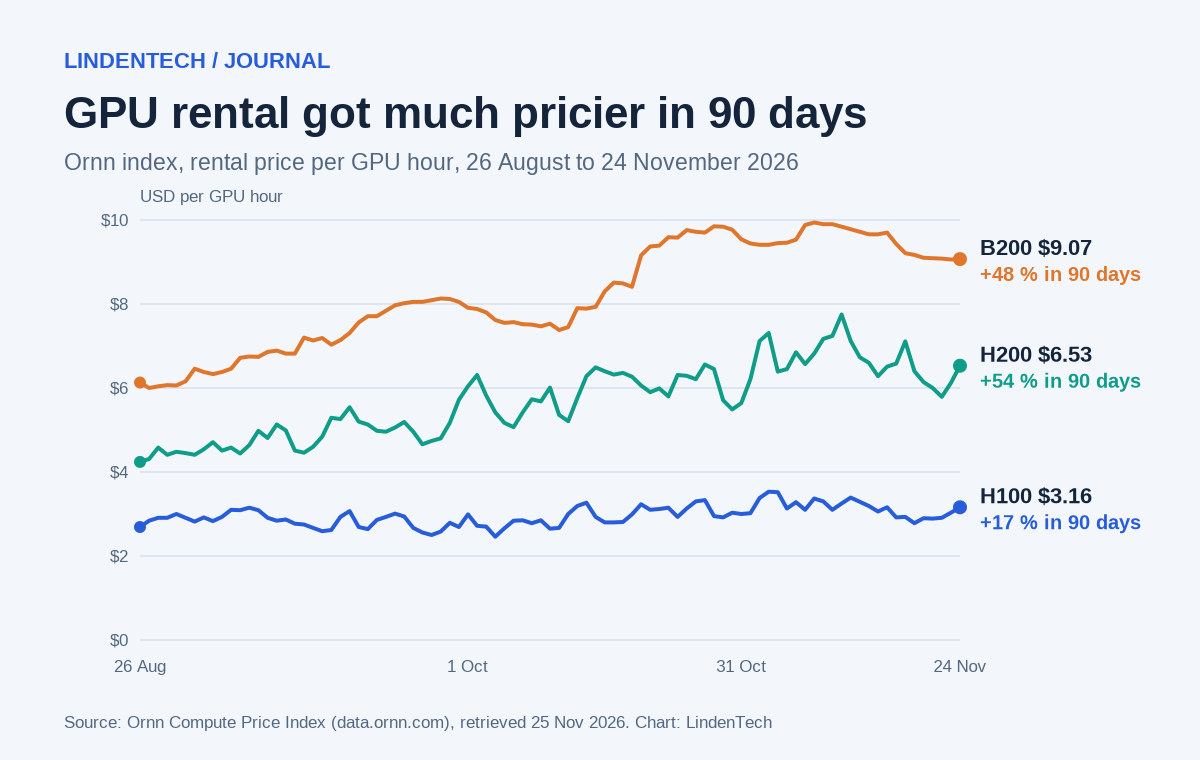
Whether AI APIs get more expensive in 2027 depends on the vendor, but they will not get more predictable. Google doubles the price of Gemini 4 Carbon on 1 December 2026 and of Gemini 3.8 Flash on 1 January 2027, and OpenAI doubles the surcharge for its fastest mode in March. Anthropic and OpenAI, on the other hand, have priced their newest models below their predecessors. At the same time, renting AI compute got 17 to 54 % more expensive within 90 days. Large companies like Revolut therefore run open models on infrastructure they choose themselves. For most mid-sized firms, a dedicated server only pays off from roughly 40 to 80 million output tokens a month. Below that, an open model through a German API is the cheaper route to fixed costs.
As of 25 November 2026. The sources are the official pricing pages of Google, OpenAI, Anthropic, Mistral and STACKIT, the Ornn index for GPU rental, and Revolut's figures from a conference talk. The break-even analysis is LindenTech's own calculation with stated assumptions, not a measurement from running a server ourselves.
At a glance: what 10 and 100 million output tokens a month cost
| Option | 10M / 100M tokens | When it makes sense |
|---|---|---|
| Claude Fable 5.2 via API | €584 / €5,838 | Hard tasks, small volume |
| Gemini 4 Carbon from 1 December | €292 / €2,919 | As above, price is rising |
| Gemma 4 31B via STACKIT (Germany) | €20 / €200 | Routine tasks, data stays in Germany |
| Mistral Small 4 via API | €10 / €96 | Classifying, summarising |
| Own GPU server at Hetzner | €2,424 / €2,424 | Large, steady volume |
The figures assume three input tokens per output token, net of VAT, at $1 = €0.91 (ECB reference rate of 24 November 2026). The rows are not equivalent: an open model with 31 billion parameters does not handle hard tasks as well as Claude Fable 5.2. Only a test with your own examples shows how much that gap matters for you.
Will AI APIs get more expensive in 2027? The price lists say: partly
The pricing pages show no single trend, but increases and cuts side by side. Gemini 4 Carbon costs $10 per million output tokens until 30 November and $20 from 1 December. Gemini 3.8 Flash goes from $3.75 to $7.50 on 1 January 2027. OpenAI's Ultrafast mode for GPT-6.2 Astra and Sol costs three times the standard rate until the end of February and six times from 1 March 2027. OpenAI and Mistral charge a 10 % uplift for endpoints that keep processing in one region, and so does Anthropic on the cloud platforms.
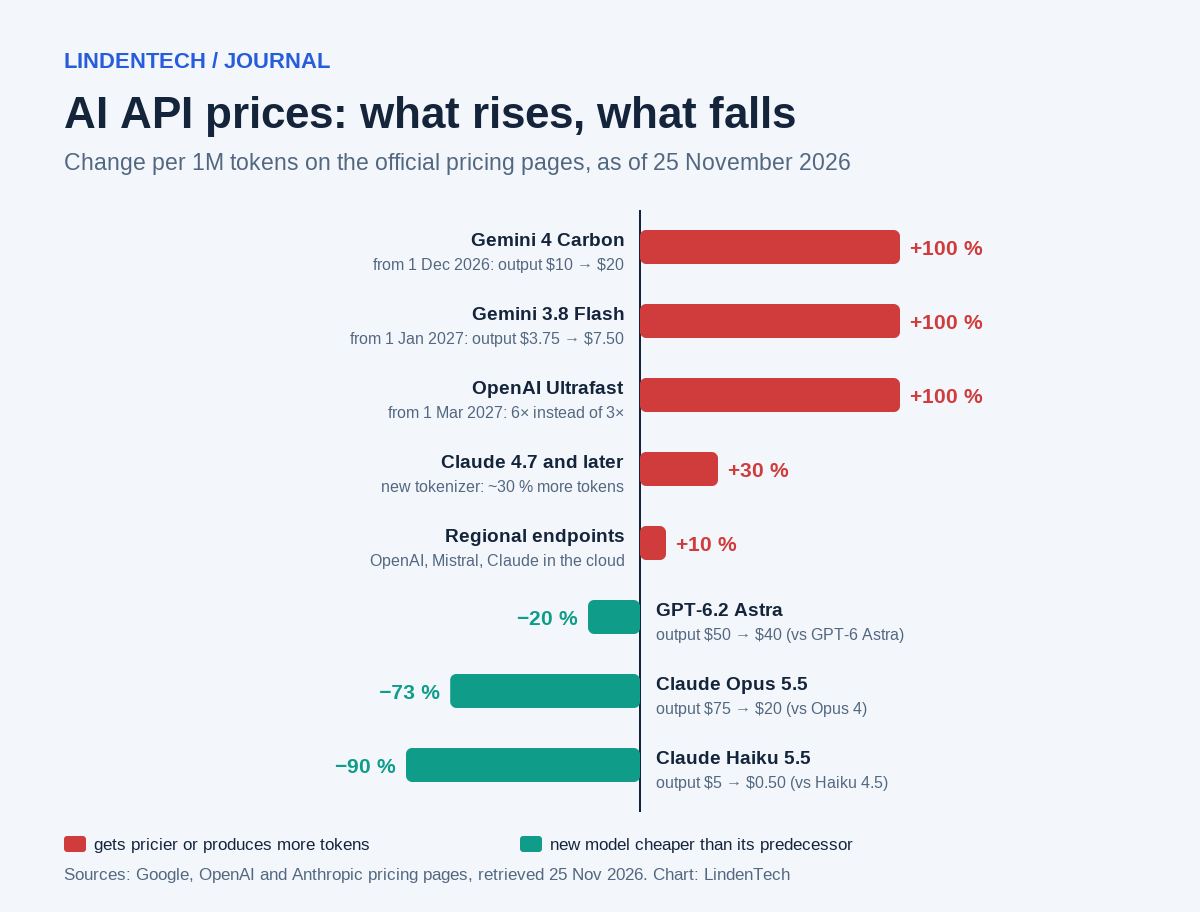
One increase does not show up in any price column. Since Claude 4.7, Anthropic has used a new tokenizer that, according to its pricing page, produces about 30 % more tokens for the same text. If you move from an older Claude model, you pay more per request at the same price per token.
On the other side, Claude Haiku 5.5 costs $0.50 per million output tokens instead of $5 for its predecessor, and GPT-6.2 Astra at $40 is cheaper than GPT-6 Astra at $50. In its IPO prospectus of 17 November 2026, Anthropic writes that it may have to cut prices or move to other models such as “outcome- or task-based pricing” (SEC filing). For your planning, this means the price may not rise, but the rules will change, often with only a few weeks' notice.
Compute is getting scarcer: what GPU rental shows
What a vendor pays for its compute shows up in the rental price of graphics processors, and that has risen clearly since the summer. The Ornn index tracks the market price per GPU hour. From 26 August to 24 November 2026 it rose from $2.69 to $3.16 for the Nvidia H100, from $4.24 to $6.53 for the H200 and from $6.13 to $9.07 for the new B200.
Demand is high in Germany too. Deutsche Telekom's Industrial AI Cloud in Munich went live in February 2026, and according to Telekom its first stage was fully booked seven months later. It is now being expanded to 20 megawatts.
Why Revolut runs its own models
Revolut moved coding assistance for about 2,000 engineers from Anthropic and OpenAI to an open model, mainly for cost and cost predictability. David Abitbol, who leads AI infrastructure at Revolut, told the AI Engineer conference in New York on 13 October 2026 that the company has run Z.ai's open GLM model since April 2026, now GLM 5.3, on 56 Nvidia B200s. Revolut puts the cost at about $0.30 per million tokens and the bill at roughly a tenth of what it used to pay Anthropic and OpenAI. A router still sends image tasks to Gemini or GPT.
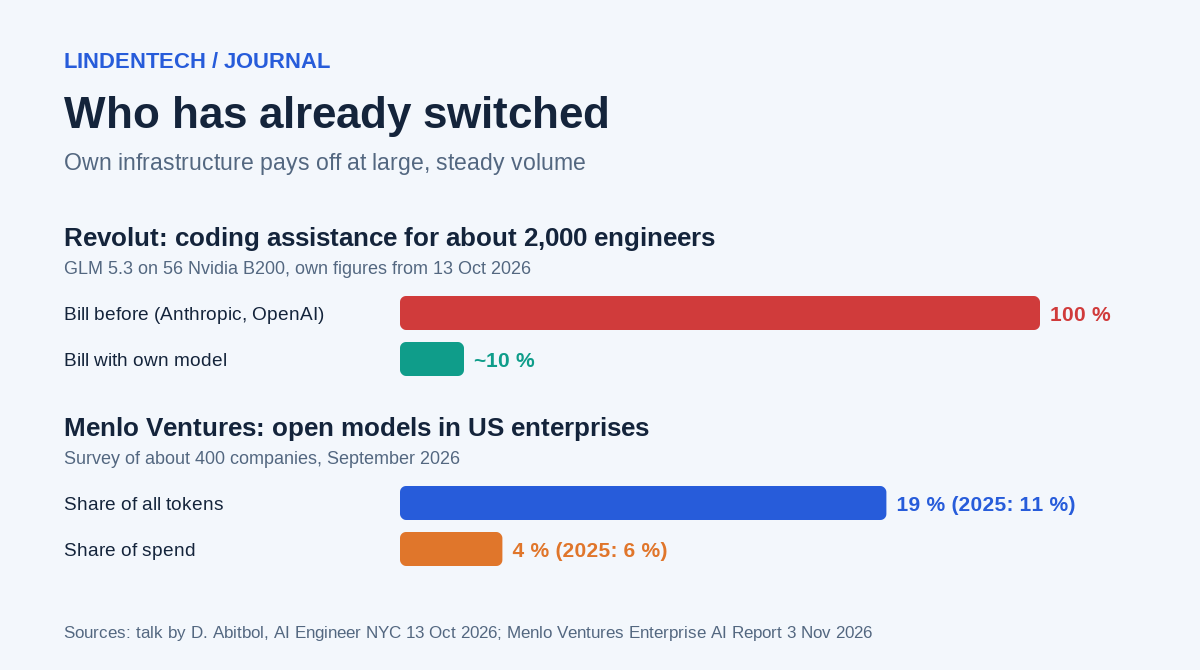
The reasoning is worth noting. As long as tokens felt scarce and expensive, engineers saved AI for the hardest tasks. With its own model, Abitbol says, the unpredictable bill goes away and teams use AI more widely. The numbers only hold for Revolut, though: renting 56 B200s at the current index price would cost about $370,000 a month by our calculation. That only pays off at a volume few mid-sized companies reach.
Revolut is not alone. According to a New York Times report, open models' share of AI use at AT&T rose from 20 to 40 %. HSBC agreed with Mistral on self-hosted models on its own infrastructure. And according to the Menlo Ventures Enterprise AI Report, open models now handle 19 % of all tokens in US enterprises but only 4 % of spend. Bulk volume moves to cheap models, while the hard tasks stay with the expensive ones.
The numbers for a mid-sized firm: API or your own server?
Your own GPU server beats a premium API from about 42 million output tokens a month, and it never beats a cheap open model via API. These are the assumptions:
- Server: Hetzner GEX131 with one Nvidia RTX PRO 6000 (96 GB) in Falkenstein, €1,499 a month plus a €1,499 setup fee spread over twelve months.
- Operations: eight hours a month for updates and monitoring at €100. Total €2,424 a month, net.
- Capacity: about 400 million output tokens a month for an open model with around 30 billion parameters. This is a cautious estimate; no published measurement exists for this card.
- API prices: three input tokens per output token, so for Claude Fable 5.2 ($8 input, $40 output) $64 or €58.38 per million output tokens.
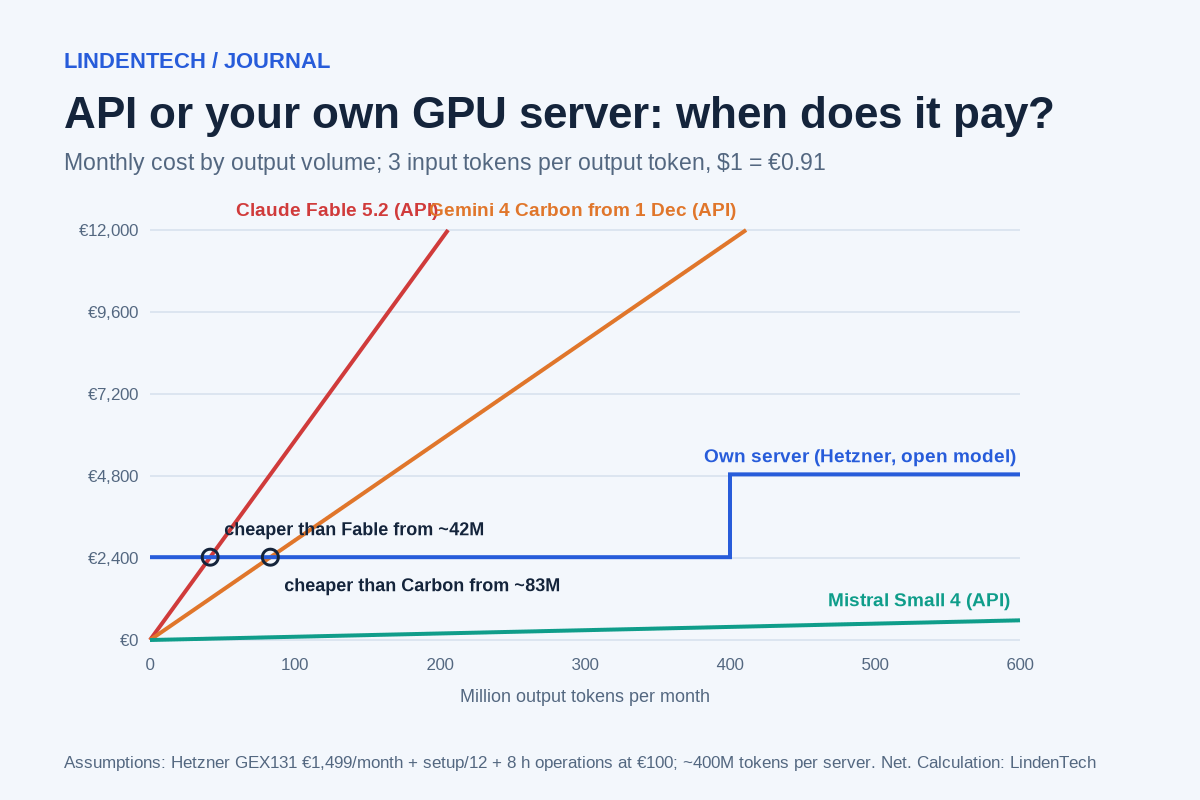
For comparison: a customer service assistant handling 10,000 requests a month with answers of about 1,000 tokens needs 10 million output tokens. That costs about €584 with Claude Fable 5.2 and about €20 with Gemma 4 31B via STACKIT. A €2,424 server would be the most expensive option here. A server pays off when many staff work with AI all day, large document volumes are processed, or data must not leave the building. Then you add a second machine for redundancy, which roughly doubles the cost.
Three steps to predictable AI costs
Predictable costs come not from choosing a vendor but from an architecture in which you can switch models. Three steps, ordered by effort:
- Make the model replaceable. Your application calls an interface in the OpenAI format, and behind it a router decides which model handles which request. Keep 30 to 50 typical cases from your daily work as a test set. Then switching after a price rise takes hours instead of weeks.
- Send routine tasks to an open model via a German API. STACKIT, the cloud of the Schwarz Group, offers Gemma 4 31B and gpt-oss-120b for €0.45 per million input tokens and €0.65 per million output tokens, processed in Germany. Only the hard cases go to Claude, GPT or Gemini.
- Rent a fixed-price server when volume is large and steady. For peaks or systems used only on working days, hourly rental is an alternative, for example an L40S at STACKIT for €1.74 an hour.
Also set a monthly budget cap with your vendor, and check in contracts with service providers who bears a price increase by the model vendor.
Frequently asked questions
Will ChatGPT, Claude and Gemini get more expensive in 2027?
At Google, yes: Gemini 4 Carbon costs twice as much from 1 December 2026, and Gemini 3.8 Flash from 1 January 2027. OpenAI and Anthropic have made their newest models cheaper but keep changing surcharges and billing rules. None of the three has announced a general price increase for 2027 (as of 25 November 2026).
What does running your own AI model on a server in Germany cost?
A Hetzner server with one Nvidia RTX PRO 6000 costs €1,499 a month plus a €1,499 setup fee. Including operations and updates we estimate about €2,400 a month net, and twice that with a second server for redundancy. The open model itself is free under licences such as Apache 2.0.
Are open-source models GDPR compliant?
An open model on a server in Germany sends no data to the model's maker. You still need a data processing agreement with the hosting provider and must check the model's licence. With a German API such as STACKIT, you sign the agreement with the API provider.
If you want to know what your AI applications would cost and which part could move to an open model, talk to us about AI automation and AI assistants. Bring the last three monthly invoices from your AI vendors and a rough count of your requests.