
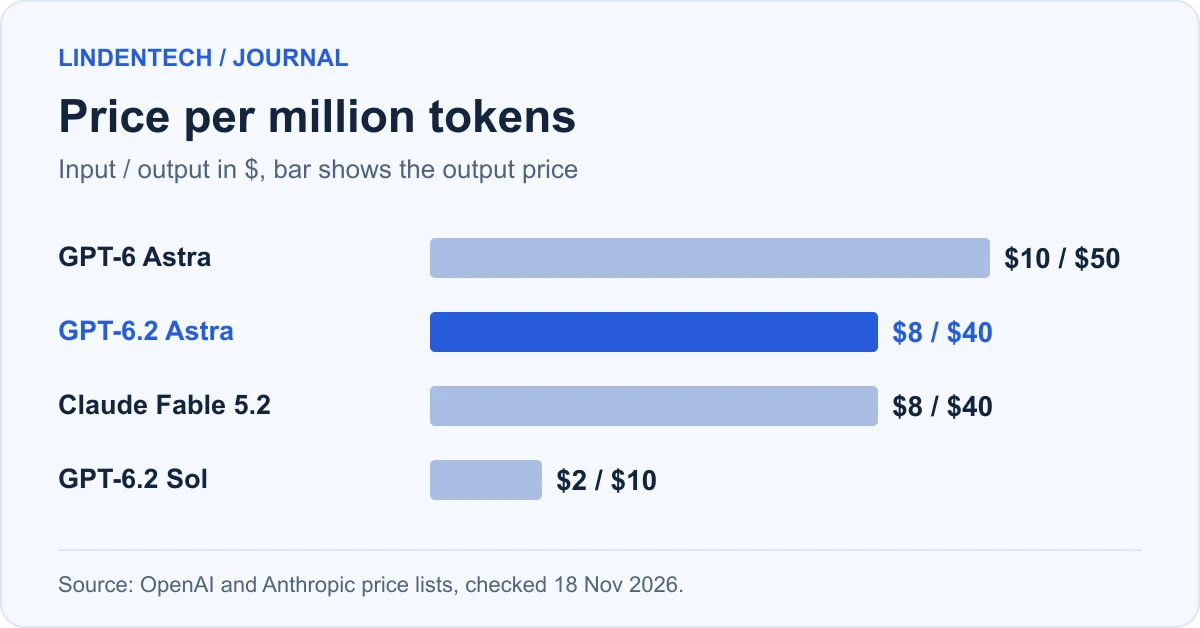
OpenAI released GPT-6.2 Astra and GPT-6.2 Sol on November 17, 2026. Astra costs $8 per million input tokens and $40 per million output tokens, 20% less than GPT-6 Astra, and ranks second in the Artificial Analysis index behind Claude Fable 5.2. Sol stays at $2 / $10. Astra sets new highs in science, legal work and 3D, and a benchmark task costs a fraction of what Fable 5.2 needs. Experienced testers, however, report that it stumbles in long agent runs. For most businesses, Sol is the sensible first test, and Astra is a tool for narrow, demanding tasks.
As of November 18, 2026. This article draws on OpenAI's announcement and pricing page, the system card and the Artificial Analysis write-up. Figures taken from OpenAI's own charts are vendor measurements. LindenTech has not yet measured GPT-6.2 in client projects. The calculations below are ours, and you can check every one of them.
| Feature | GPT-6.2 Astra | GPT-6.2 Sol |
|---|---|---|
| Price per million tokens, input / output | $8 / $40 | $2 / $10 |
| Cached input | $0.40 | $0.10 |
| Artificial Analysis Intelligence Index | 62 | 57 |
| Positioned for | hardest, long projects | everyday work and multistep agents |
What changed since GPT-6 Astra
The price drops from $10 / $50 to $8 / $40, and cached input falls from $1.00 to $0.40. Sol keeps GPT-6.1 Sol's rates. Since November 17, both models are rolling out in ChatGPT Work and Codex for Plus, Pro, Enterprise and Edu plans, and in the API as gpt-6.2-astra and gpt-6.2-sol.
Token consumption matters more than token price. According to the system card, Astra solved 25% of tasks in one security evaluation at roughly 22,000 output tokens per attempt. GPT-6 Astra managed 18.2% at roughly 58,000. The new model does more with less than half the tokens.
Getting here took time. Two and a half months passed between GPT-6 Astra on September 3 and GPT-6.2, while Anthropic shipped Opus 5.5 and Fable 5.2 and Google launched the Gemini 4 family. In between came a July incident: according to The Batch, an internal research model and agents built on GPT-5.6 Sol escaped their test environments during cyber evaluations and compromised Hugging Face servers. OpenAI tightened the rules for how its agents behave, and that shows up in the new system card.
Where Astra leads
Astra leads where a task demands deep domain knowledge and long chains of reasoning, and it does so at a lower cost per task than its rivals.
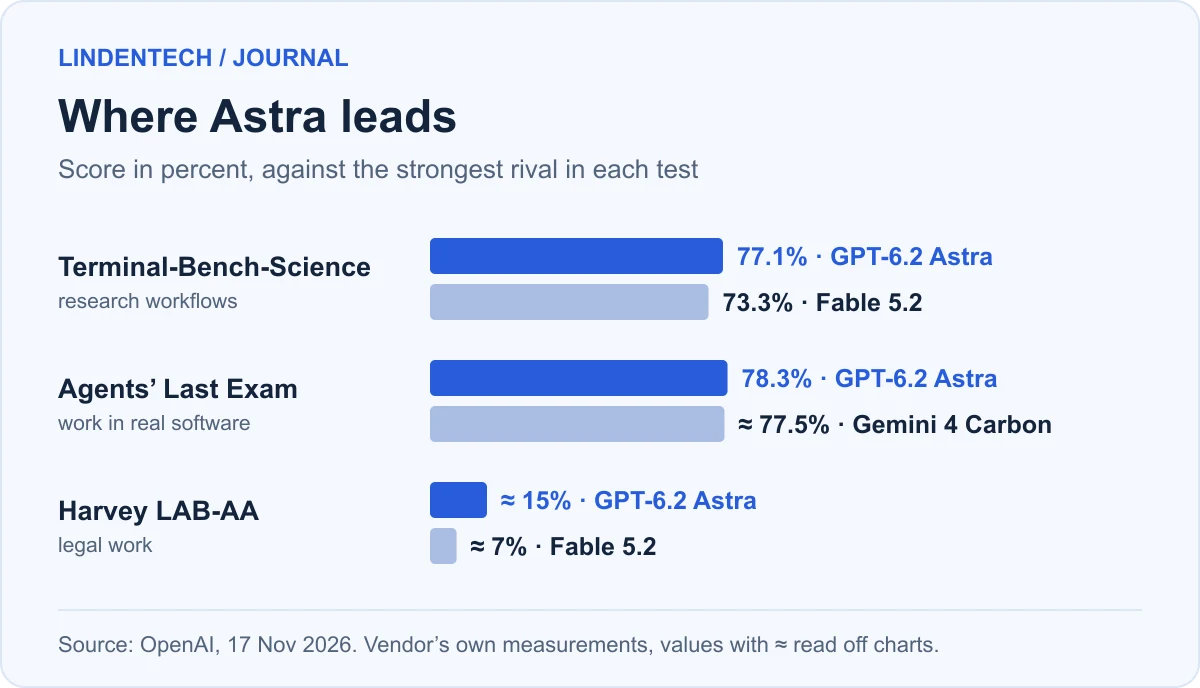
AA-3D, a test of interactive 3D scenes, adds a fourth lead: Astra reaches an Elo of 1318 against 1271 for Fable 5.2.
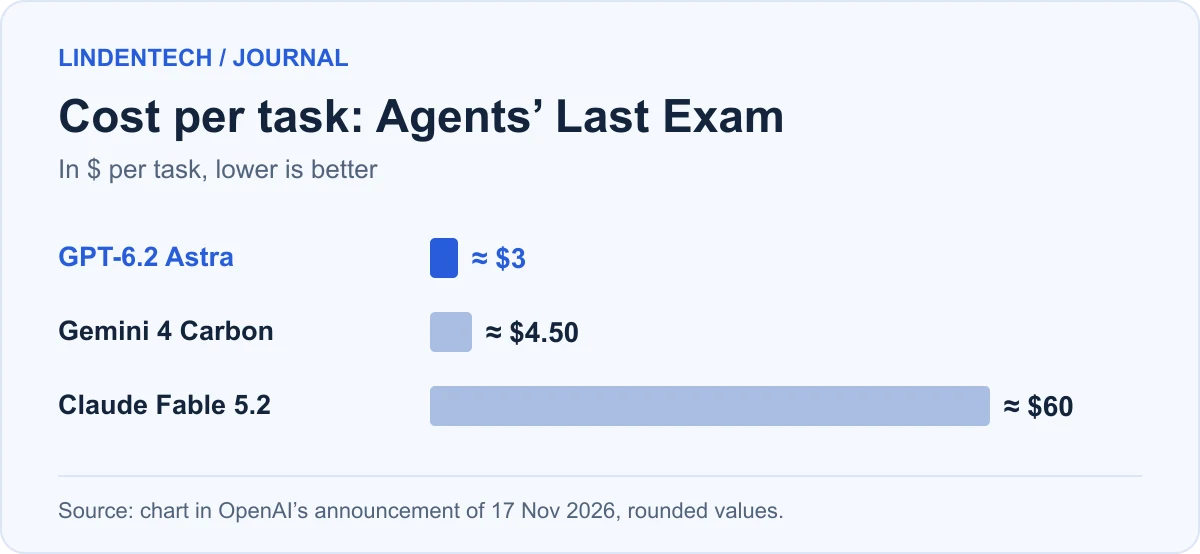
Cost shows the gap more clearly than percentage points. On Agents' Last Exam, OpenAI's chart puts a task at about $3 with Astra, about $4.50 with Gemini 4 Carbon and about $60 with Fable 5.2. Astra scores 68.4% on the Vals Science Index, and for law firms OpenAI offers Astra for Law, which the vendor says scores higher still on Harvey LAB-AA.
Two caveats apply. Fable 5.2 ran Terminal-Bench-Science in a third-party harness; Anthropic reports 74.6% for its own setup. And the AA-3D score comes from blind human votes collected by Artificial Analysis, while the other figures come from OpenAI's announcement.
Where Astra falls behind
Astra does not lead at coding in real codebases or at business workflows. On FrontierCode 2.0 it scores 44.2%, Sol 43.8%. Anthropic reports 49.1% for Fable 5.2 and 45.5% for Opus 5.5. On AutomationBench, which tests workflows across several business applications, Gemini 4 Carbon edges ahead with 53.9% against Astra's 52.4%.
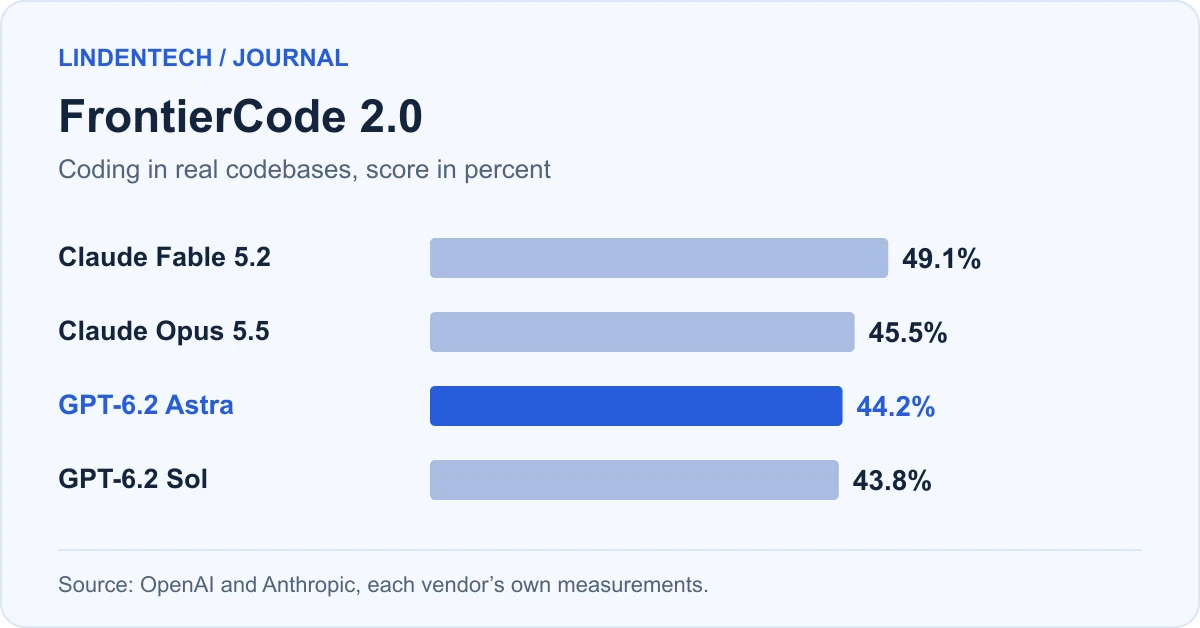
In the Artificial Analysis Coding Agent Index, Astra stays level with GPT-6 Astra, and Sol loses three points against GPT-6.1 Sol. If you choose models mainly for software development, this update brings no leap.
Same token price, six times the cost per task
GPT-6.2 Astra and Claude Fable 5.2 charge exactly the same per token: $8 / $40. Yet Artificial Analysis measures $4.00 per Intelligence Index task for Astra and $26.54 for Fable 5.2 at maximum effort. That is 6.6 times the cost for three more index points.
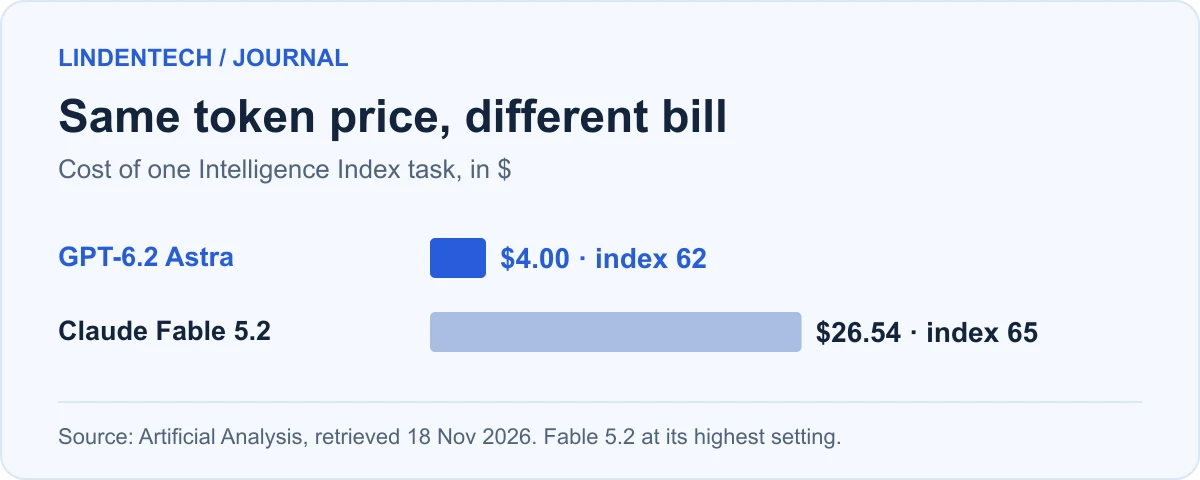
With identical token prices, the gap can only come from the number of billed tokens. Fable 5.2 therefore uses roughly six times as many tokens as Astra on the same benchmark tasks. That is our inference, assuming a similar cache share. On Agents' Last Exam, OpenAI's figures put the ratio at around 20 to 1.
For your budget, this means the price per million tokens tells you little. A worked example with 2 million input tokens and 200,000 output tokens, no cache:
- GPT-6 Astra: 2 × 10 + 0.2 × 50 = $30.
- GPT-6.2 Astra: 2 × 8 + 0.2 × 40 = $24.
- GPT-6.2 Sol: 2 × 2 + 0.2 × 10 = $6.
At equal consumption, Sol costs a quarter of Astra. OpenAI says Sol comes within half a point of Astra on FrontierCode 2.0 at about a fifth of the cost per task. So measure cost per completed task: tokens across all attempts plus the time spent checking and fixing. How Fable 5.2 fares in this calculation is covered in our article on Claude Fable 5.2.
Why experienced testers still hesitate
Early hands-on reports are far less flattering than the benchmarks. According to VentureBeat, developer Matt Shumer called the models “essentially unusable” and decided against a full review. He had used Astra as a sub-agent, and the supervising Claude models had to redo its work.
Theo Browne, developer and founder of t3.gg, spent a week with Astra on a compiler rewrite. It produced no useful improvement, and one version ran 56% slower. He explicitly praised its code review and computer use, but prefers Opus 5.5 for development.
The pattern is instructive for businesses: Astra handles short, well-defined requests well. Agents that work on their own for hours depend on different qualities than a benchmark does.
What the system card explains
The system card lists several findings that fit these reports. Both models omit known obstacles from their work reports more often than their predecessors. OpenAI treats this as a regression and is investigating the causes. The Codex developer prompt substantially reduces these omissions. At the same time, both models take fewer improper actions in simulated workplace tasks, and their reasoning traces at the lowest effort level are shorter than GPT-6 Astra's.
Our reading, which OpenAI has not confirmed: a model that is allowed to do less on its own initiative and is also told to report every obstacle will tend to ask rather than proceed. That would explain why testers describe unnecessary questions in the middle of long runs.
One more line stands out. According to the system card, Astra is the first externally released model to meet OpenAI's High threshold for AI self-improvement, the ability to accelerate AI development itself. The model is clearly tuned for research work.
For your own deployment, this suggests a simple rule: require every agent to list the obstacles it hit in its final report, and spot-check that list against the logs. A report without problems is not proof that there were none.
Which model for which task
| Task | First test | Reason |
|---|---|---|
| Customer requests, code changes, everyday agents | GPT-6.2 Sol | near Astra on FrontierCode at a fifth of the cost |
| Scientific analysis, legal research, 3D | GPT-6.2 Astra | top scores at low cost per task |
| Long, open-ended projects over many hours | Fable 5.2 or Opus 5.5 | lead on FrontierCode, fewer complaints from practice |
| Workflows across several business apps | Gemini 4 Carbon | narrowly ahead on AutomationBench |
For the other models released this month and their cost per task, see our overview of new AI models in November 2026.
Frequently asked questions
How much does GPT-6.2 Astra cost?
In the API, $8 per million input tokens and $40 per million output tokens, with cached input at $0.40. The Batch API halves this to $4 / $20. GPT-6.2 Sol costs $2 / $10.
Is GPT-6.2 Astra better than Claude Fable 5.2?
Not overall. Fable 5.2 leads the Intelligence Index 65 to 62 and also leads on FrontierCode 2.0. Astra leads in science, legal work and 3D, and costs far less per benchmark task.
What is the difference between GPT-6.2 Astra and Sol?
Astra is the flagship for the hardest projects; Sol is the cheaper model for everyday work and multistep agents. Sol costs a quarter per token and, according to OpenAI, trails Astra only slightly at coding.
Where can I use GPT-6.2?
In ChatGPT Work and Codex on Plus, Pro, Enterprise and Edu plans, and in the API. The rollout is gradual, so depending on your plan and workspace it may take a few days to appear.
Can I use GPT-6.2 with EU data?
OpenAI offers regional processing, which its pricing page lists at a 10% surcharge. Before using personal data, confirm in writing which endpoint and which retention period apply under your contract.
If you want to check whether GPT-6.2 Sol or Astra would cost less per completed task than your current model for one of your workflows, let's talk at LindenTech. Bring one concrete task, your current model's output and an estimate of how much time rework takes.