
An AI agent can answer customer questions and prepare tasks on WhatsApp. Reliable operation requires more than a phone number, however: a suitable business account, a permitted use case, working message reception and an available person to handle exceptions.
One point is especially important when budgeting in September 2026: the 24-hour window remains a sending rule, not a permanent promise of free replies. Meta has announced changes to service messages and utility templates for 1 October 2026. Older price comparisons may therefore become misleading within weeks.
Business App or Business Platform?
The WhatsApp Business App is an application for direct customer communication. The Business Platform and its Cloud API provide an interface through which software can process messages. This is the relevant starting point for custom integrations and AI workflows. A provider may add a shared inbox on top; that inbox is not automatically included with API access.
Before switching, check whether to migrate your existing number or use app/API coexistence if supported for your account. A functioning personal WhatsApp account is neither a technical integration nor proof that an unattended bot may be run through it.
What must be ready before the first real customer conversation?
| Component | Questions to resolve |
|---|---|
| Business account | Who owns and manages the Meta Business Portfolio and WhatsApp Business Account, or WABA? |
| Phone number | Who controls the number and can confirm its registration? What happens to existing operations? |
| Technical access | Direct Cloud API integration or a provider; appropriate permissions, secure credentials and HTTPS message reception |
| Operational approvals | Display name, account status, any required business documents and the sending limits actually enabled |
| Billing | Payment method, contract currency, Meta tariff and provider charges |
| Customer service | Who takes over, during which hours, and with what conversation context? |
Meta lets you get started with a test configuration. Business verification, app review and a visible verification badge are different things. Requiring full business verification before every API test is too sweeping. Promising unlimited scaling of a test account without further checks would be equally wrong. The requirements and limits of the specific account are what matter. The official Cloud API getting-started guide explains test access, permissions and the steps towards integration.
The 24-hour window, explained with a Monday example
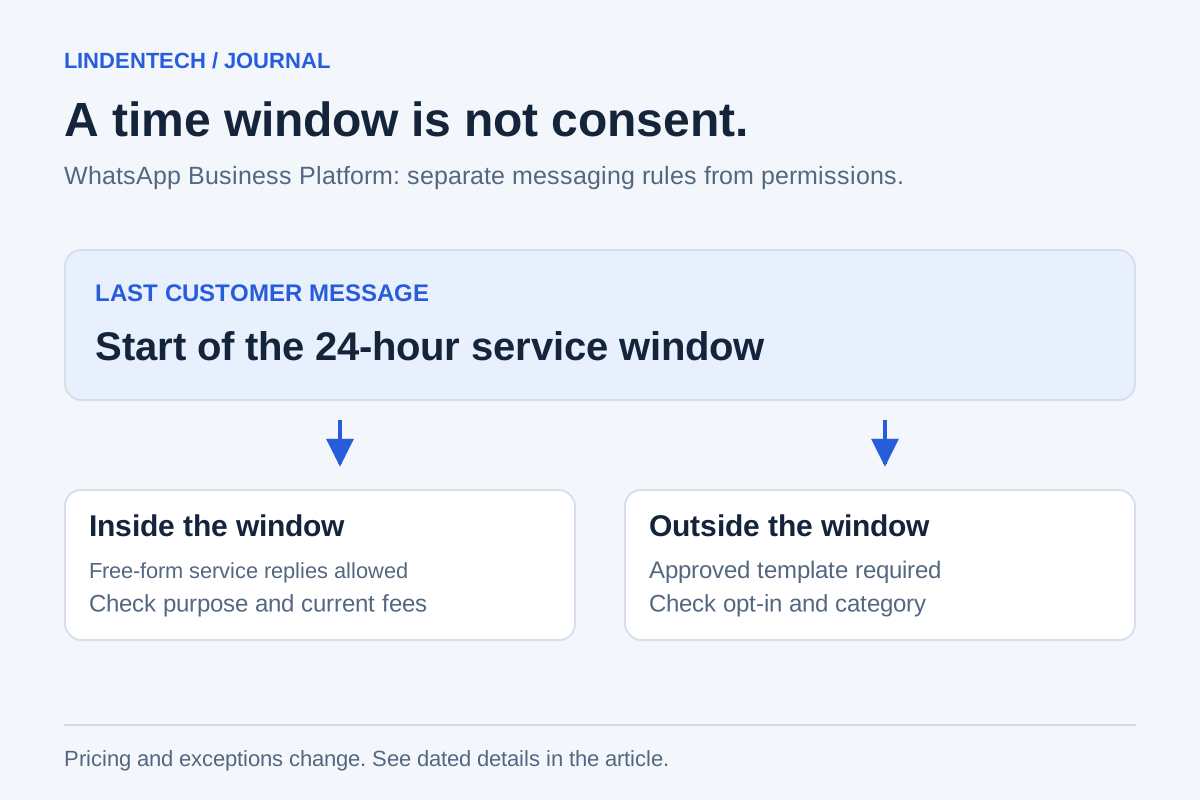
A customer writes at 09:00 on Monday: “Has my order been shipped?” This opens or resets the customer service window. Free-form replies without a template are possible within 24 hours of the customer's latest message.
If the customer replies again at 16:00 on Monday, the window lasts until 16:00 on Tuesday. A message from your bot alone does not extend it. To contact the customer again on Wednesday, you need an approved template and appropriate permission to make contact. A template does not automatically open another free-form reply window; a new customer message is what matters.
An approved template does not replace opt-in either. The phone number, expected purpose and ability to opt out must align. Automation also needs a clear escalation route. The WhatsApp Business Messaging Policy requires this; an accessible phone number or another direct contact route allowed by that policy may form part of it.
Which message incurs a charge, and when?
This table concerns ordinary business communication handled by a person or an external AI solution. Separate rules for general-purpose AI providers and Meta's own agent platform must be distinguished from it.
| Message type | As of 10 September 2026 | Announced from 1 October 2026 |
|---|---|---|
| Free-form service reply within the 24-hour window | No Meta delivery fee under the ordinary service model | Charged per service message |
| Utility template within the open window | Currently no Meta delivery fee | Charged per utility message |
| Utility template outside the window | Category- and market-based billing | Corresponding billing continues |
| Marketing or authentication template | Generally category- and market-based; check special windows | Corresponding billing continues |
| Message through Meta Business Agent | Token-based Meta billing since 1 August 2026 | Separate tariff continues; no duplicate charge for the same service message |
Meta explains the changes and the distinction between its own agent platform and external AI in the documentation for non-template messages. Check the current rate cards for the recipient market and contract currency. We deliberately do not repeat unverified German per-message rates from third-party blogs.
A qualifying entry through Click-to-WhatsApp ads or certain Facebook Page buttons can trigger a special 72-hour free-delivery window. This is not a blanket exemption for every web link. Advertising costs and any AI consumption remain separate items. Check the entry conditions before including this window in a budget.
How to calculate a month's costs
Count delivered messages by category, not just customers or conversations. A dialogue with four bot replies may generate four billable service messages. For operations planned from October onwards, a simple calculation is:
Monthly cost = service messages × service rate + billable templates × their respective rates + provider charges + AI usage + operations.
For example, 2,000 conversations with four service replies each mean budgeting for 8,000 outgoing service messages before applying any qualifying special windows or free allowances. This assumption does not require an invented per-message price. The provider should show the applicable rate card, any markups and included services separately. Our AI assistant cost example explains the model component.
Can any AI service be offered on WhatsApp?
No. The terms distinguish a business being supported by an AI service provider from offering general-purpose AI technology as the main functionality. The terms dated 6 March 2026 that were accessible on our review date include an exception for the latter when users have EEA or Brazilian country codes. Saying “all AI bots are banned” would therefore be as wrong as saying “every kind of AI is permitted everywhere”. Source: WhatsApp Business Solution Terms.
There are also separate pricing rules for AI Providers. These do not automatically apply to every small trade business using AI for its own customer support. Have your particular service's classification checked before launch. Contractual rules on reusing conversation data must also be respected by the model provider involved.
The acceptance test before launch
Test a normal conversation, a message after the window expires, a rejected template, an opt-out, a duplicate message delivery and an AI provider outage. When a person takes over, the bot must stop responding in parallel. The team needs the case, ownership and next steps in one place.
Mentioning encryption is not enough for data protection. Clarify contractual roles, recipients, retention and possible processing in third countries throughout the entire chain. The WhatsApp Data Processing Terms do not replace the assessment of your additional providers.
Checked on 10 September 2026. If you plan to launch from October, the new pricing logic already belongs in your quotation. Checking the specific account and tariff is part of implementation, not a formality afterwards.