
Between 9 and 12 November 2026, five major language models were released or became generally available: Anthropic's Claude Fable 5.2, Meta's Muse Ember, Google's Gemini 4 Carbon and Gemini 4 Hydrogen, and a preview of Alibaba's Qwen4-Max. Fable 5.2 is still the strongest and Muse Ember the cheapest. For most businesses, Gemini 4 Hydrogen is the news that matters: it replaces Gemini 3.8 Flash, and in an independent comparison one task costs about a quarter as much. Put two dates in your calendar: Gemini 4 Carbon's introductory price ends on 30 November, and Gemini 3.8 Flash doubles in price on 1 January 2027.
As of 13 November 2026. This article draws on the vendors' announcements, price lists and model pages, plus the leaderboard of Artificial Analysis. That independent tester runs every model through the same nine task suites and publishes the cost per task next to the index score. Figures from announcements are the vendors' own measurements and are labelled as such. LindenTech has not yet measured the new models in its own projects.
| Model | Price per 1M tokens, input / output | Use it for |
|---|---|---|
| Claude Fable 5.2 | $8 / $40 | long, hard tasks |
| Gemini 4 Carbon | $2 / $10, from 1 Dec $4 / $20 | hard tasks, planning |
| Gemini 4 Hydrogen | $1.50 / $7.50 | everyday work, agents |
| Muse Ember | $0.10 / $0.50 | high-volume steps, extraction |
| Qwen4-Max Preview | subscription only, until 25 Nov | trying it in coding tools |
What does one task cost? The new models on the index
The token price tells you little about the bill, because models burn very different numbers of tokens on the same job. Cost per completed task is the more useful figure. We pulled the new models and their main rivals out of the Artificial Analysis leaderboard.
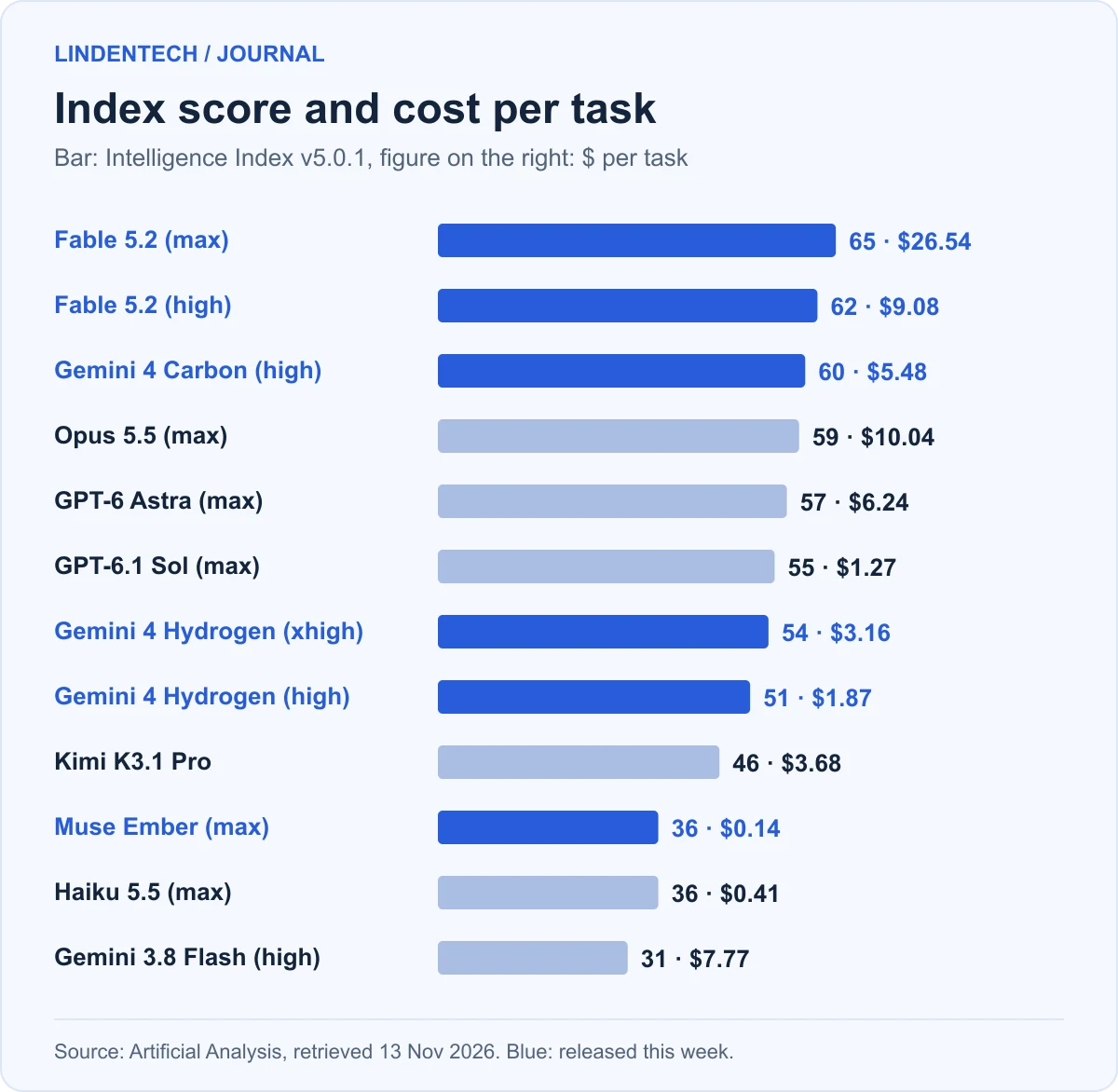
The gaps below first place say more about which model to pick than the winner does. At its default high setting, Gemini 4 Hydrogen scores 51 for $1.87 per task. Gemini 3.8 Flash, the model Hydrogen replaces, scores 31 for $7.77. A Hydrogen token costs twice as much, yet the task is more than four times cheaper. Hydrogen is faster too: 7.9 minutes per task against 14.7. That is close to twice as fast; Google quotes 2.5 times for its own tests.
Muse Ember and Claude Haiku 5.5 both score 36. Ember gets there for $0.14 per task, Haiku for $0.41, almost three times as much. Meta's announcement cites exactly this measurement.
With Fable 5.2, look at the effort levels. On max it scores 65 for $26.54, on high 62 for $9.08. The last three points cost almost three times as much, and even on high Fable 5.2 is ahead of every other model in the list. Gemini 4 Carbon on high, with 60 points for $5.48, matches Opus 5.5 on max (59 points, $10.04) at just over half the cost.
An index score is an average across nine task suites covering coding, research and office work. It tells you which models belong on the shortlist. Whether a model reliably handles your invoice checks or your customer requests only shows up when you test it on your own cases.
Gemini 4 Carbon: strong, but only cheap until 30 November
Google announced Carbon on 28 October and first released it only to security teams. Since 10 November it has been open to all paying developers and businesses through the Gemini API and Gemini for business, and to consumers on the Google AI Ultra plan. There is no free tier.
According to the price list, Carbon costs $2 per million input tokens and $10 per million output tokens until 30 November. From 1 December it is $4 and $20, the same per token as Opus 5.5. If token use stays the same, the cost per task doubles too. If you want to test Carbon, the next two weeks are the cheapest time to do it.
Google itself does not recommend Carbon as the default. It says Gemini 4 Argon remains the right choice for most coding and knowledge work, and that Carbon is meant for tasks at the limit of what models can do, spending more tokens to get there. The leaderboard tells a different story: Argon on high scores 50 for $4.97, Carbon 60 for $5.48. Ten extra points cost about 10% more in this test. Google also highlights Carbon's security results, such as 88.2% on SEC-bench Pro for finding vulnerabilities; that is a vendor figure as well.
Gemini 4 Hydrogen: Google's new default
Hydrogen launched on 12 November at $1.50 per million input tokens and $7.50 per million output tokens, flat across its whole one-million-token context window. Google's developer documentation calls it the recommended upgrade from Gemini 3.8 Flash. Google reports that Hydrogen solves 57% of Terminal-Bench 4.1 tasks, against 18.2% for 3.8 Flash.
Hydrogen replaces more than Flash. On high it reaches Argon's index score (51 against 50) for just over a third of the cost per task. For everyday work on Google's stack, it is the obvious first choice.
Switching is more than a new model ID. Hydrogen thinks at the high level by default, ignores temperature, top_p and top_k, and drops explicit caching. Before you switch, check whether your prompts and cost estimates depend on those settings. There is a free tier, but there Google uses your inputs to improve its products. For business data, only the paid tier is an option.
Muse Ember: Haiku-level results for a third of the cost
Meta introduced Muse Ember on 9 November as its smallest and most efficient model. It costs $0.10 per million input tokens and $0.50 per million output tokens, three times that for prompts over 200,000 tokens. The context window is one million tokens. Ember is available through the Meta Model API, in Muse Code, and on Google Cloud and Oracle Cloud. The weights are not open.
Meta pitches Ember at the work agents repeat all day: tool calls, routing, data extraction and parsing long documents. In Meta's own measurements, Ember solves 37.8% of AutomationBench-AA business workflow tasks, against 13.9% for Haiku 5.5 and 20.2% for GPT-6 Luna. For code, Haiku is ahead: on FrontierCode 2.0-AA, Ember scores 27.2% and Haiku 34.9%.
Fable 5.2 and Qwen4-Max in brief
Claude Fable 5.2 tops the index and costs $8 / $40 per million tokens. We cover its benchmarks, worked cost examples and when Opus 5.5 is enough in our article on Claude Fable 5.2. Until 16 November, Fable is still included in the Claude Pro and Team plans.
Qwen4-Max arrived as a preview on 11 November, and Alibaba says it will be retired after 25 November. Access is only through the Token Plan subscription, from $6 a month or $3 for new customers. Alibaba explicitly limits it to interactive use in coding and agent tools, not automation scripts or your own application backends. There are no benchmarks and no model card yet. For business processes, Qwen4-Max is a preview of what is coming, not a candidate.
On November 17, OpenAI followed with GPT-6.2 Astra and Sol. What both cost and where they beat Fable 5.2 is covered in our GPT-6.2 review.
The shared pattern: a big model plans, a small one does the work
Three vendors independently give the same advice. Anthropic recommends Opus 5.5 as the starting point and Fable 5.2 as an advisor for hard individual questions. Google describes Carbon as the coordinator that plans and clears roadblocks, while Hydrogen edits code, runs tests and handles subtasks in parallel. In Google's Antigravity development environment, that pairing came close to Carbon's success rate on its own, using 24% less quota and finishing 19% faster, according to Google. Meta recommends pairing Ember with its large Muse Wonder model.
For your business, the question is no longer which model is best but which pair. The cost gap is wide. One index task costs $0.14 with Ember and $9.08 with Fable 5.2 on high, about 65 times as much. Every step the small model handles reliably saves almost the whole amount. So measure, on your own cases, what share of the steps the small model completes without rework.
Deadlines: what changes before January
| Date | What changes | What you can do |
|---|---|---|
| 16 Nov 2026 | Fable promotion in Claude Pro and Team ends | test it on a real task now |
| 25 Nov 2026 | Qwen4-Max Preview is retired | keep it out of workflows |
| 30 Nov 2026 | last day of Carbon and Argon at $2 / $10 | test Carbon now |
| 1 Dec 2026 | Carbon and Argon cost $4 / $20 | redo the budget |
| 1 Jan 2027 | Gemini 3.8 Flash costs $1.50 / $7.50 | switch to Hydrogen |
From January, Gemini 3.8 Flash costs the same per token as Hydrogen but scores 20 points lower on the index. By then at the latest, there is no reason to stay on Flash.
Data protection: what the announcements leave out
None of the five announcements says where data is processed or how long it is kept. Where answers exist, they sit in the documentation behind the launch posts.
At Google, Hydrogen and Carbon run on Vertex AI with processing in the “eu” multi-region, which means within EU member states. Google's data residency overview does not list single regions such as Frankfurt for these models. On the paid Gemini API, Google's terms say inputs are not used to improve its products but are logged for a limited time to detect abuse, possibly outside the EU. Applications with users in the EEA may only use the paid services.
Fable 5.2 requires 30-day data retention; a zero-retention mode is available only with Anthropic's approval. Qwen4-Max processes requests globally, with access through Singapore. For Muse Ember, we found nothing on Meta's developer pages about retention, training on customer data or processing location. Get these points in writing before any personal data goes to one of these models.
Frequently asked questions
Which AI model is the strongest in November 2026?
Claude Fable 5.2. On the Artificial Analysis index it scores 65, ahead of Gemini 4 Carbon at 60 and Opus 5.5 at 59. It is also the most expensive: $26.54 per test task at the highest setting.
Which new model is the cheapest?
Meta's Muse Ember, at $0.10 per million input tokens and $0.50 per million output tokens. On the index, one task costs $0.14 for the same score as Claude Haiku 5.5, which needs $0.41.
Should I switch from Gemini 3.8 Flash to Gemini 4 Hydrogen?
On the Artificial Analysis numbers, yes: 51 points instead of 31 at about a quarter of the cost per task. From 1 January 2027 both cost the same per token. Test first whether your integration relies on temperature or explicit caching.
When does Gemini 4 Carbon get more expensive?
On 1 December 2026. The price rises from $2 / $10 to $4 / $20 per million tokens. Gemini 4 Argon doubles on the same date.
Can I use the new models with customer data from the EU?
With Google, yes, through Vertex AI in the “eu” multi-region or through the paid Gemini API with the limits its terms describe. Fable 5.2 keeps data for 30 days. Muse Ember has no public statement on this, so ask the vendor before you use it.
If you want to know which pair of models costs least per completed task in one of your workflows, talk to LindenTech. Bring one specific workflow, the model you use today and your monthly volume.