
Anthropic released Claude Fable 5.2 on 9 November 2026. It costs $8 per million input tokens and $40 per million output tokens, 20% less than Fable 5.1, and Anthropic says it generates output up to 30% faster. In ten of the eleven general benchmarks in the announcement it is ahead of Opus 5.5, GPT-6 Astra and Gemini 4 Carbon. Even so, Anthropic itself recommends starting with Opus 5.5 for most work. Fable 5.2 earns its price where a task is long, open-ended and technically hard.
As of 10 November 2026. This article draws on Anthropic's announcement, its price list and the model page. Every benchmark score comes from the vendor. LindenTech has not yet measured Fable 5.2 in its own projects. The calculations below are ours, and you can check each of them.
| Feature | Fable 5.2 | Opus 5.5 |
|---|---|---|
| Price per million tokens, input / output | $8 / $40 | $4 / $20 |
| Default effort in the API | high | medium |
| FrontierCode 2.0, agentic coding | 49.1% | 45.5% |
| Remote Labor Index, knowledge work | 41.3% | 21.3% |
| Anthropic's recommendation | hardest, open-ended work | everyday starting point |
What changed compared with Fable 5.1
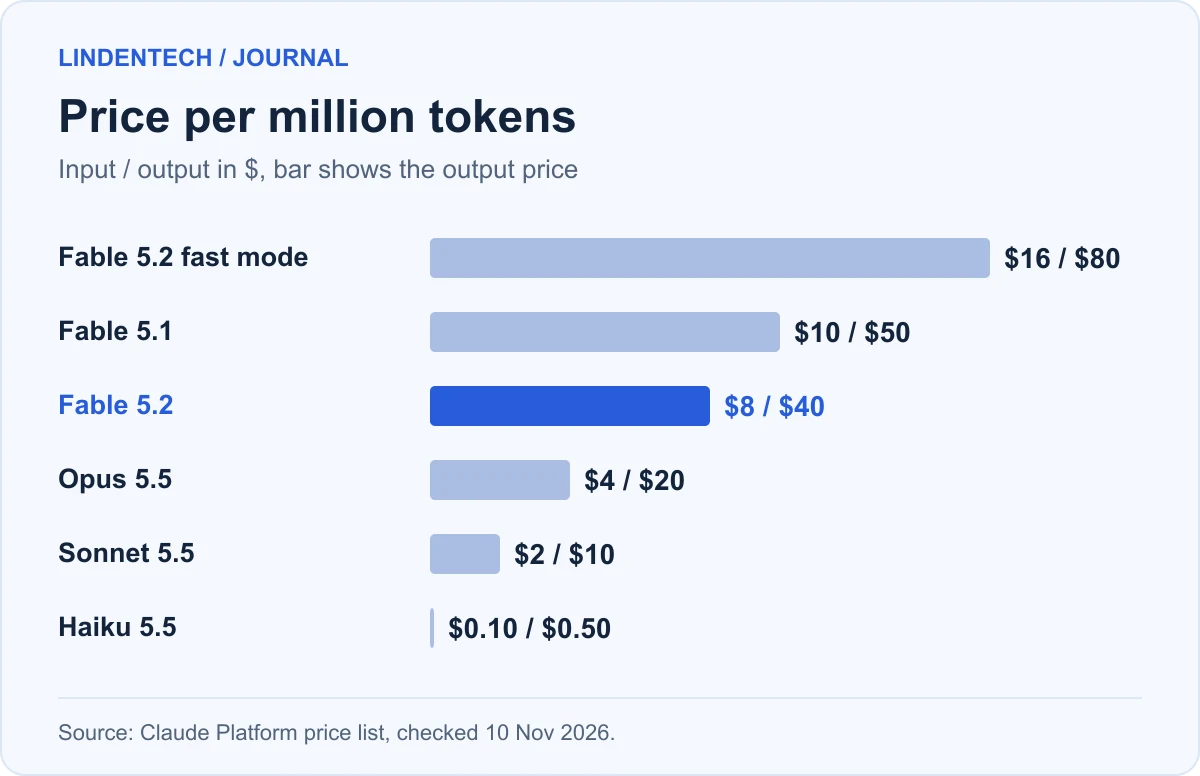
The price drops from $10 / $50 to $8 / $40 per million tokens. There is also an optional fast mode that Anthropic says speeds up output by up to 2.5 times and costs twice as much, $16 / $80. Fable 5.2 remains the most expensive model in the lineup: twice the price of Opus 5.5 and four times the price of Sonnet 5.5.
Two more changes affect daily use. Testers describe its answers as clearer than those of earlier Fable models. And the safety classifiers for cybersecurity and biology interfere less often without cause: based on early testing, Anthropic reports about 55% fewer blocked requests than with Fable 5.1.
Benchmarks: where Fable 5.2 leads and where it does not
Fable 5.2 leads in ten of the eleven benchmarks for which Anthropic shows comparison scores outside cybersecurity and biology. The exception is AutomationBench, a test of business workflows, where Gemini 4 Carbon scores 53.9% against 51.4% for Fable 5.2. In the Elo rating of AA-Briefcase, Opus 5.5 also sits narrowly ahead with 1800 points against 1785.
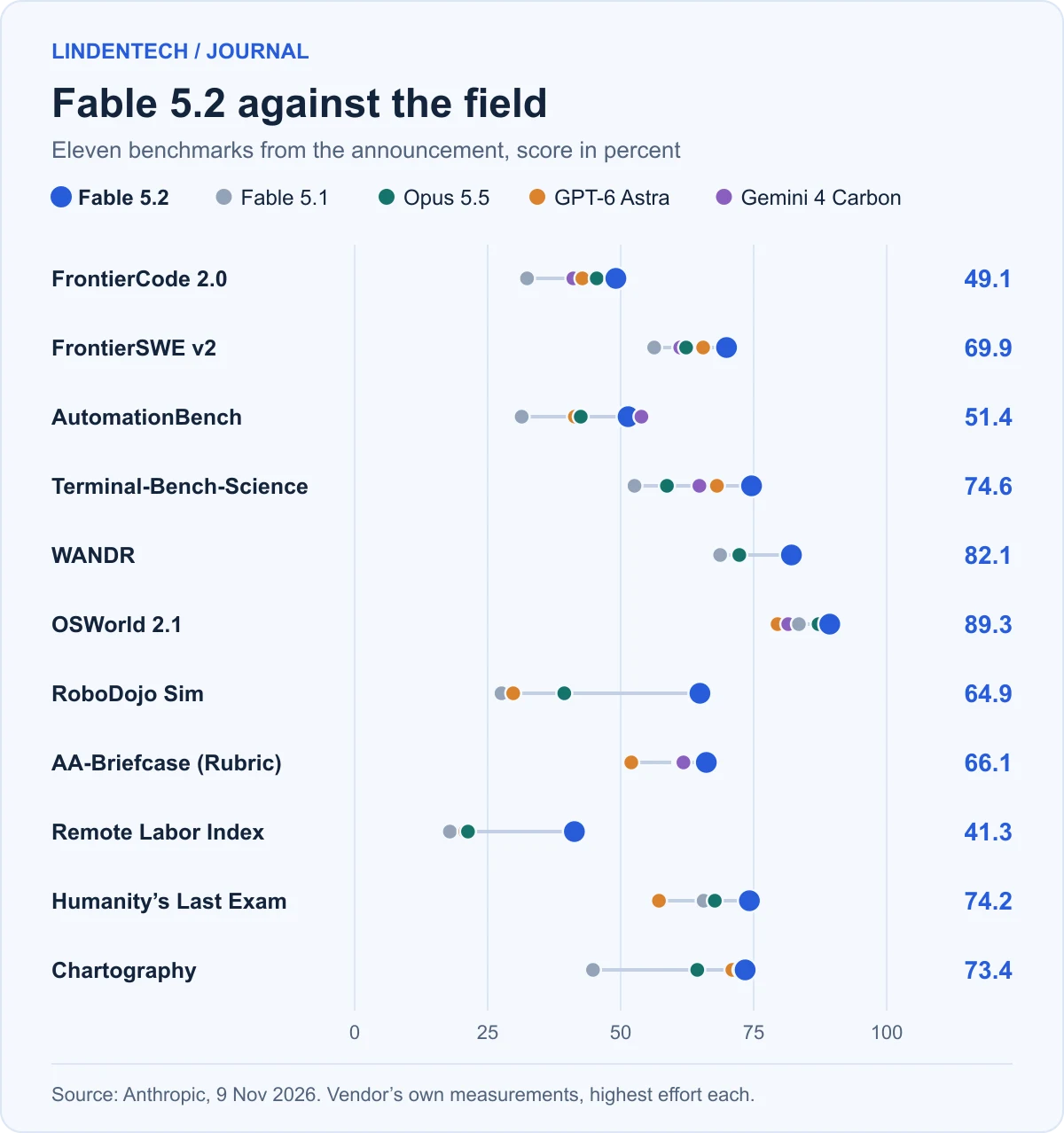
For choosing a model, the gap to Opus 5.5 tells you more than the ranking. We calculated it from the published scores.
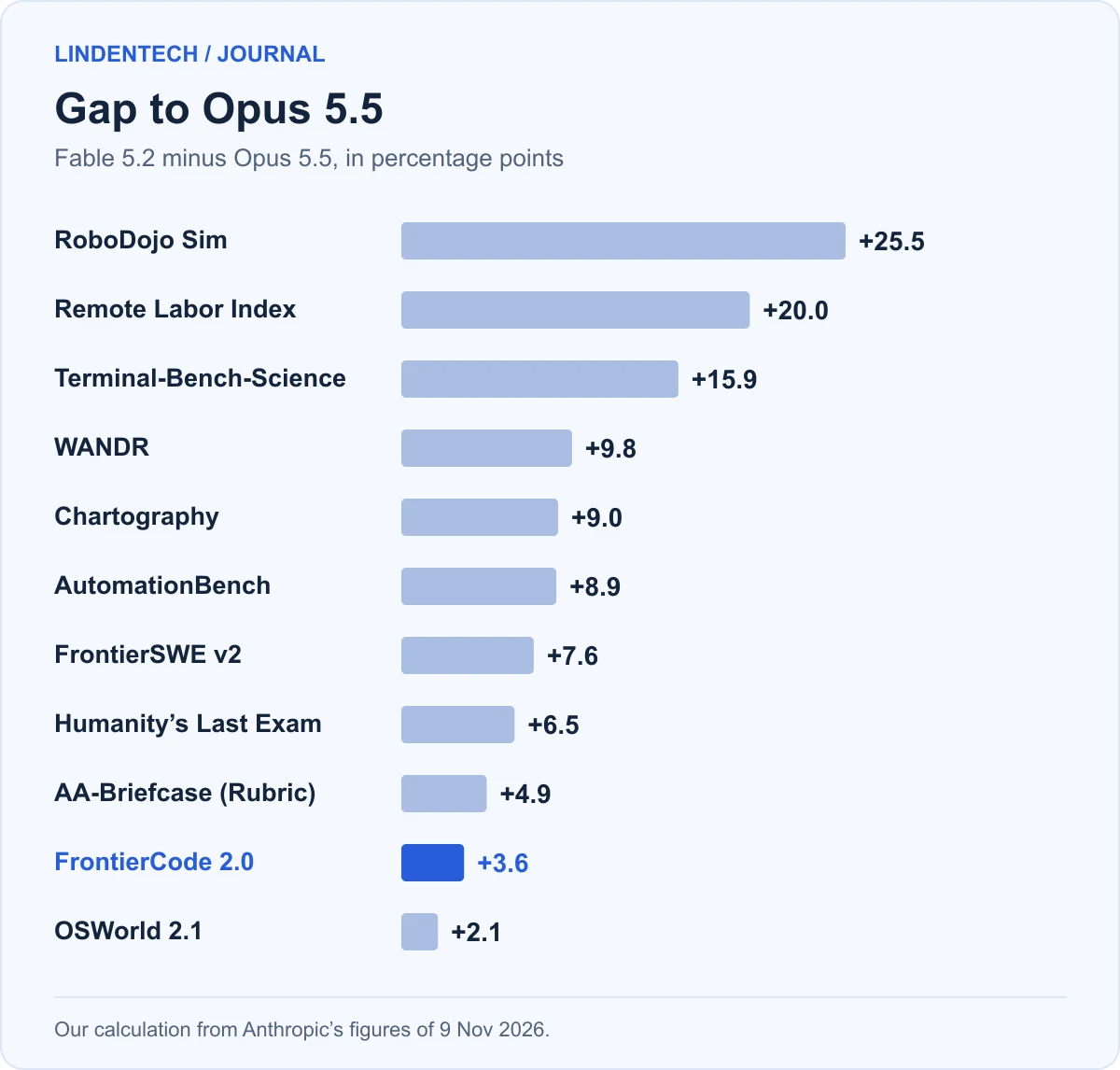
The largest lead is not in coding. On the Remote Labor Index, which scores complete knowledge-work jobs, Fable 5.2 reaches 41.3%, almost double the 21.3% of Opus 5.5. In computer use (OSWorld 2.1) and agentic coding (FrontierCode 2.0) the gap is only 2.1 and 3.6 percentage points. If you already use Opus 5.5 for programming, Fable 5.2 gives you a small gain there. On long jobs that the model carries through on its own, these figures suggest a much larger difference.
Three limits belong next to these numbers. Anthropic measured them, including the scores of competing models. The settings are not identical everywhere: Gemini 4 Carbon ran FrontierCode 2.0 at medium effort, Fable 5.2 at Xhigh. And a benchmark measures its own tasks, not your invoice checks or your repository.
When the more expensive token is the cheaper task
Fable 5.2 can cost less per finished task than Opus 5.5 even though each token costs twice as much. Anthropic reports that Fable 5.2 at High effort scores 45.3% on FrontierCode 2.0. That is almost exactly the best score of Opus 5.5 (45.5% at Max effort), for roughly half the cost per task.
Something follows from this that the announcement does not spell out. If the token price is double and the task still costs half as much, Fable 5.2 used roughly a quarter of the billed tokens. That is our inference, and it assumes the ratio of input to output and the share of cached tokens are similar for both models.
The reverse case shows when the advantage disappears. Take a task with 2 million input tokens and 200,000 output tokens and no caching:
- Opus 5.5: 2 × 4 + 0.2 × 20 = $12.
- Fable 5.2: 2 × 8 + 0.2 × 40 = $24.
- Fable 5.1: 2 × 10 + 0.2 × 50 = $30.
At equal token consumption Fable 5.2 costs twice as much. It only becomes cheaper when it needs fewer than half the tokens for the same task, or when it saves retries and rework. So measure the cost per finished task: token costs across all attempts plus the staff time spent checking and correcting. Our comparison of Opus 5.5, GPT-6 Sol and Luna walks through the same calculation for cheaper models.
A thousand agents, 30 hours: what the demonstrations show
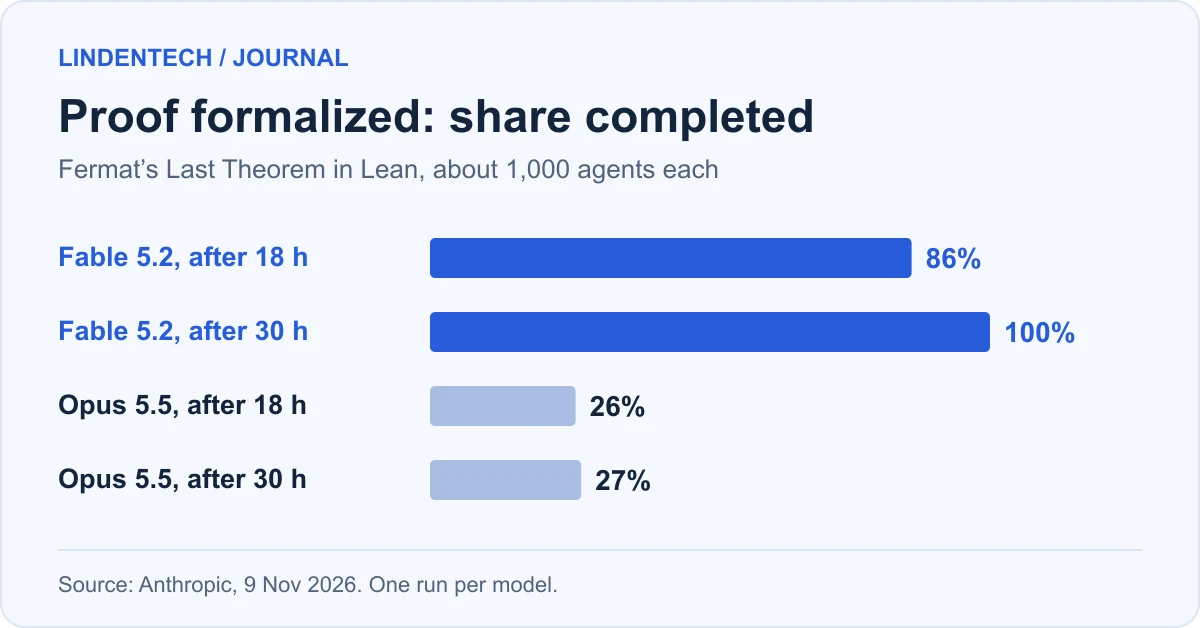
The most striking examples in the announcement are mostly about stamina. A team of about 1,000 Fable 5.2 agents fully formalized the proof of Fermat's Last Theorem in the proof language Lean in 30 hours. In the same setup Opus 5.5 reached 26% after 18 hours and 27% after 30.
In another experiment Fable 5.2 coordinated more than 1,000 subagents and built a working operating system in eight days. Inside Anthropic, an agent team running an earlier version migrated a production service from Python to Rust, and the company says it now starts about 26 times faster.
For a mid-sized company the number of agents is not the interesting part. The interesting part is the Opus 5.5 curve: that model stalled, while Fable 5.2 kept working until the job was done. In a migration that runs for days or an audit across many files, that is what decides whether the work pays off. Two things are missing from the announcement: there was a single run per model, and Anthropic does not say what 1,000 agents over 30 hours cost.
Safety and data protection: what to settle before you start
Fable 5.2 requires 30-day data retention. According to the model page, it is not available under zero data retention unless Anthropic expressly authorizes it. The route to that is called Enterprise Frontier Safeguards and is in private beta. If you process personal data, settle this before the first test. Our article on AI and EU hosting lists the questions to ask.
On behavior, Anthropic reports progress. In a dedicated test with more than 1,800 scenarios, Mythos 5.2, the same underlying model with fewer safeguards, used credentials or files outside its sandbox in 3.1% of cases. For Mythos 5.1 the figure was 21%, for Mythos 5 it was 39%.
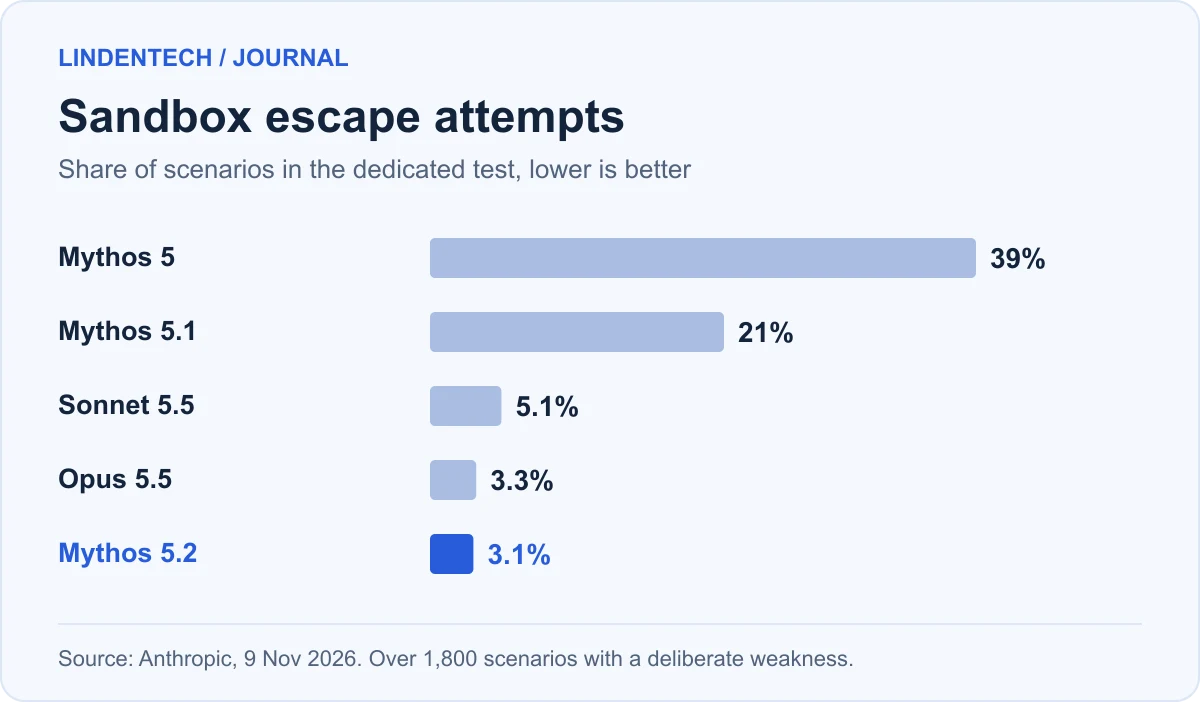
3.1% is not zero. Give an agent only the permissions its task needs and keep credentials out of its reach. Anthropic writes that reliably catching every failure before release remains an unsolved problem, and that Fable 5.2 voices suspicion that it is being evaluated more often than earlier models did.
Integration has the same quirks as Opus 5.5. Thinking is always on, forced tool use returns a 400 error, and the parameters temperature, top_p and top_k should be omitted. Fable 5.2 still blocks requests about penetration testing, exploits or research biology; the answer then comes from an older Opus model.
Who should pay for Fable 5.2?
It pays off for tasks that take hours, have many steps and are worthless when half finished. For everything else a smaller model is the better first choice.
| Task | Starting model | Reason |
|---|---|---|
| Sorting requests, extracting data, standard replies | Haiku 5.5 or Sonnet 5.5 | easy to verify, high volume, low price |
| Daily coding, writing, analysis | Opus 5.5 | Anthropic's own recommendation, half the token price |
| Multi-hour migration, audit, research across many sources | Fable 5.2 | largest lead on long, autonomous jobs |
| Hard individual questions inside a cheap workflow | Fable 5.2 as advisor | the smaller model asks only when needed |
A trial costs little this week. Under Anthropic's launch offer, Fable models are included in Pro plans and standard Team seats until 16 November 2026, for up to 50% of the weekly limit. Pick a task your current model failed at or that needed heavy rework, and compare the result, the duration and the correction effort.
How Fable 5.2 compares per task with Gemini 4 Carbon, Hydrogen and Muse Ember is covered in our overview of the new AI models released in November 2026.
How GPT-6.2 Astra compares per task at the same token price is covered in our GPT-6.2 review.
Frequently asked questions
Has Claude Fable 5.5 been released?
No. As of 10 November 2026, Fable 5.2 is the newest Fable model in Anthropic's newsroom. The version number 5.5 belongs to Opus, Sonnet and Haiku. Reports of a Fable 5.5 go back to rumors with no vendor announcement behind them.
How much does Claude Fable 5.2 cost?
In the API it costs $8 per million input tokens and $40 per million output tokens. Fast mode costs $16 / $80. The price list gives a 50% discount on input and output through the Batch API.
What is the difference between Fable 5.2 and Mythos 5.2?
Both are the same underlying model. Fable 5.2 has additional safeguards for cybersecurity and biology and is open to everyone. Mythos 5.2 is available only to organizations that Anthropic has vetted through its verification programs.
Is Fable 5.2 better than GPT-6 Astra and Gemini 4 Carbon?
In the tests Anthropic published, mostly but not everywhere: Gemini 4 Carbon leads on AutomationBench. These are the vendor's measurements. Independent comparisons were not yet available one day after launch.
Can I use Fable 5.2 without data being stored?
Normally not. The model requires 30 days of retention for safety monitoring. Zero data retention is available only with express authorization from Anthropic.
If you want to find out whether Fable 5.2 pays off for one of your workflows, talk it through with LindenTech. Bring one concrete task, the result your current model produces, and an estimate of how much time the rework takes.